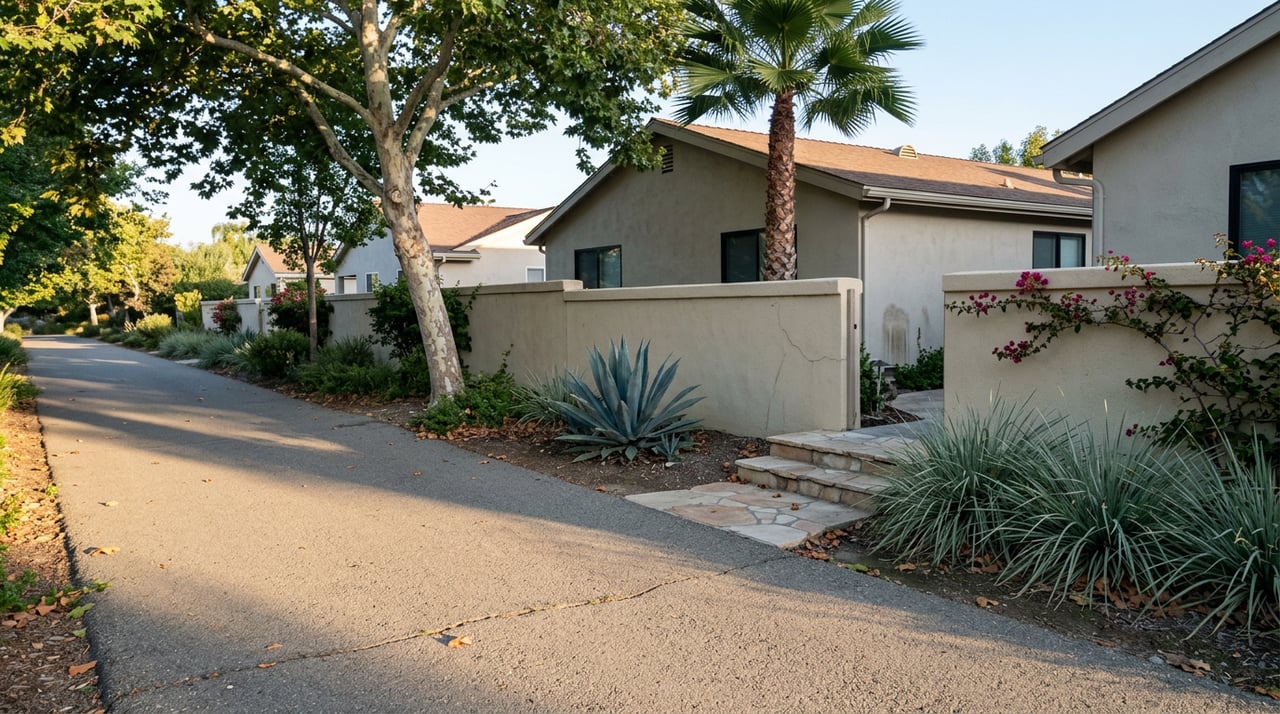
Every morning, dog walkers and stroller pushers and a handful of commuters on beat-up cruisers move through the six-inch-wide slice of shade under the sycamores on the Whittier Greenway Trail, and most of them walk right past a bronze plaque explaining why the trail smells like citrus at the western end and iron at the eastern one. The trail has been open since 2009. The city estimates more than half a million people use it every year. And the vast majority of those trips involve zero contact with what the trail is actually built to teach you, which is the order Whittier grew in.
The Greenway runs on an abandoned rail spur, 7.3 miles from Pioneer Boulevard near the 605 to the Orange County line, after a 2.8-mile extension finished the job in 2023. Along the way, the city built six themed rest stops it calls stations, each one keyed to a different chapter of Whittier's past. Walk or ride the whole thing and you're not just getting exercise. You're moving through the town's economic history in a sequence nobody laid out for you on purpose, but that works anyway.
The Six Stops, and What They're Actually For
The stations aren't evenly spaced trivia. Each one sits where its subject matter happened.
| Station | Location | What It Marks |
|---|---|---|
| Citrus Station | South of Penn Street | The packing houses that shipped Whittier's oranges and lemons by rail |
| Palm Station | Palm Park | Whittier's Spanish, Victorian, and Craftsman architecture |
| Walnut Station | Mid-trail | Fitness stop |
| Laurel Station | Mid-trail | Fitness stop |
| Sycamore Station | Near Five Points | Native trees and the shift from wagons to railroads to cars |
| Oak Station | North of Lambert Road | Whittier's founding as a Quaker colony and Pio Pico's homestead |
Citrus Station tells you how the town made its money. Palm Station shows you the buildings that money paid for, including a pergola built from rescued architectural columns pulled from the old Fred C. Nelles School site and the Theisen Building in Uptown, a project funded through a Southern California Edison grant routed by the Whittier Conservancy. Sycamore Station, near the Five Points intersection, walks you through the corridor's shift from wagon roads to the Pacific Electric and Union Pacific lines. Oak Station, the farthest east of the original stops, goes back further still, to the Quaker families who founded the town and to Pio de Jesus Pico, the last governor of Alta California under Mexican rule, whose homestead sits nearby as a state park.
Here's the part that makes the order interesting rather than just informative. Oak Station is the newest of the six. The city built it in 2019, specifically to introduce the extension project that was still years from breaking ground. So the exhibit that tells the oldest story on the trail is also the most recently constructed marker, and it sits at the exact spot where the newest pavement begins. Walking east, you're moving forward through construction dates and backward through the town's own timeline at the same time.
At Oak Station, a line from the town's namesake poet is set into the sidewalk itself:
"The joy that you give to others is the joy that comes back to you."
John Greenleaf Whittier wrote that line more than a century before anyone paved a bike path named after him, and the city chose to put it under your feet at the one station built to explain who he was.
The Building at Citrus Station Never Actually Stopped Working
Most history stations describe a place that used to be something. Citrus Station is different because the building it's describing is still standing, still occupied, and still open for business at the corner of Penn Street and Whittier Boulevard.
The Whittier Citrus Association built its packing house there in 1902 and expanded it in 1904. By 1906, the plant was shipping roughly 650 carloads of oranges and 250 carloads of lemons a year by rail, making it one of the largest citrus packing operations in the state. The building stayed in citrus production until 1951. It sat through several changes of ownership before becoming King Richard's Antique Center in the late 1970s, and Chuck and Martha Garcera have owned it since 2008. Today it's 57,000 square feet across multiple floors, home to more than 300 dealer booths, and it markets itself as the largest antique mall in California. There's still an on-site restaurant inside, tucked at the back of the complex.
So Citrus Station isn't a plaque describing a vanished economy. It's a plaque standing next to the actual building, still full of people, still doing commerce, just selling vintage furniture instead of lemons.
The Wind Sculptures Have a Name Attached
The kinetic mobiles you see turning near Palm Park, the Five Points bridge, and the trail's south end aren't generic public art. They're the work of Lyman Whitaker, a sculptor based in New Mexico whose wind-driven pieces have shown up in galleries and public spaces well beyond Whittier. A rider who covered the full trail this month noted the sculptures by name in a post about the ride, which tells you the pieces are distinctive enough that a first-time visitor clocks the artist without needing to look it up on-site.
The 2.8 Miles That Took Longer Than the Ribbon Cutting Suggests
The original 4.6-mile trail opened in 2009. The extension that finally pushed it to the Orange County line took considerably longer. Construction on the 2.8-mile addition started in February 2021, funded through an $8.1 million mix of state, federal, and local money, and ran into enough coordination snags with an adjacent traffic signal project and Union Pacific's active rail line that costs grew by roughly $300,000 before the ribbon cutting on August 18, 2023, at First Street and Lambert Road. Then-Mayor Joe Vinatieri and Congresswoman Grace Napolitano, who had spent years negotiating right-of-way access with the railroad, were both on hand for the ceremony, along with representatives from La Habra's city government, since the extension runs directly to that border.
The new stretch looks and feels different from the original path, and there's a physical reason for that. The 2009 trail sits inside a landscaped corridor roughly 60 feet wide. The extension runs through a much tighter, 15-foot strip alongside an active rail line, with far less room for the trees and flower banks that shade the older section. A rider who did the whole out-and-back this month mentioned turning around near the Mills Avenue bridge because the final two miles run mostly in direct sun. Three years after the ribbon cutting, plenty of regulars still treat Oak Station as the practical end of the ride, even though the trail keeps going.
The Friday Morning Bookend
If you're building a weekend loop around the trail, Uptown Whittier gives you a natural start or finish. The Uptown Whittier Farmers Market runs every Friday, year-round, from 8 a.m. to 1 p.m. at 13018 Philadelphia Street, organized through the Whittier Uptown Association. Park in Uptown, work through the market stalls, then head down toward Citrus Station and King Richard's before doubling back. It turns a bike ride into a morning that also restocks your kitchen.
What the Trail Actually Tells You
None of this changes what the Greenway Trail is for on a practical level. It's still where you walk the dog, where your kid learns to ride a bike without traffic, where you get your steps in before the heat sets in for the day. But the six stations were built with real intent, and the order they sit in happens to mirror something true about Whittier itself: a town that built its wealth on citrus, built its architecture on that wealth, and only recently got around to building a proper marker for the founders who started the whole thing. That's not a coincidence you'd notice from a car window. You only get it by walking the corridor slowly enough to read the plaques you've been riding past for years.
Understanding a place at that level, the buildings that never stopped working, the extension that split opinion among longtime users, the market that anchors a Friday morning, is the same kind of groundwork that goes into knowing what a specific block or a specific house is actually worth. If you're curious what your own corner of Whittier looks like from that vantage point, reach out to Daniel P. Garcia and request a free home valuation and renovation plan.