For years, the HOA resale packet in a Brea condo sale was a stack of paperwork buyers skimmed and lenders filed. Starting January 1, 2026, one page inside that packet decides whether your listing closes on the first offer wave or stalls into the second week of escrow.
That page is the SB 326 exterior elevated element inspection report. Civil Code §4525 now requires it inside the disclosure package a Brea seller hands to every prospective buyer in a condominium community. If the association has one and it looks clean, your sale moves. If the association never ordered one, or if the report flags rot that has not been repaired, three parties respond in ways that are outside your control: the buyer's lender, the buyer's insurer, and the buyer.
The line item that moved into §4525
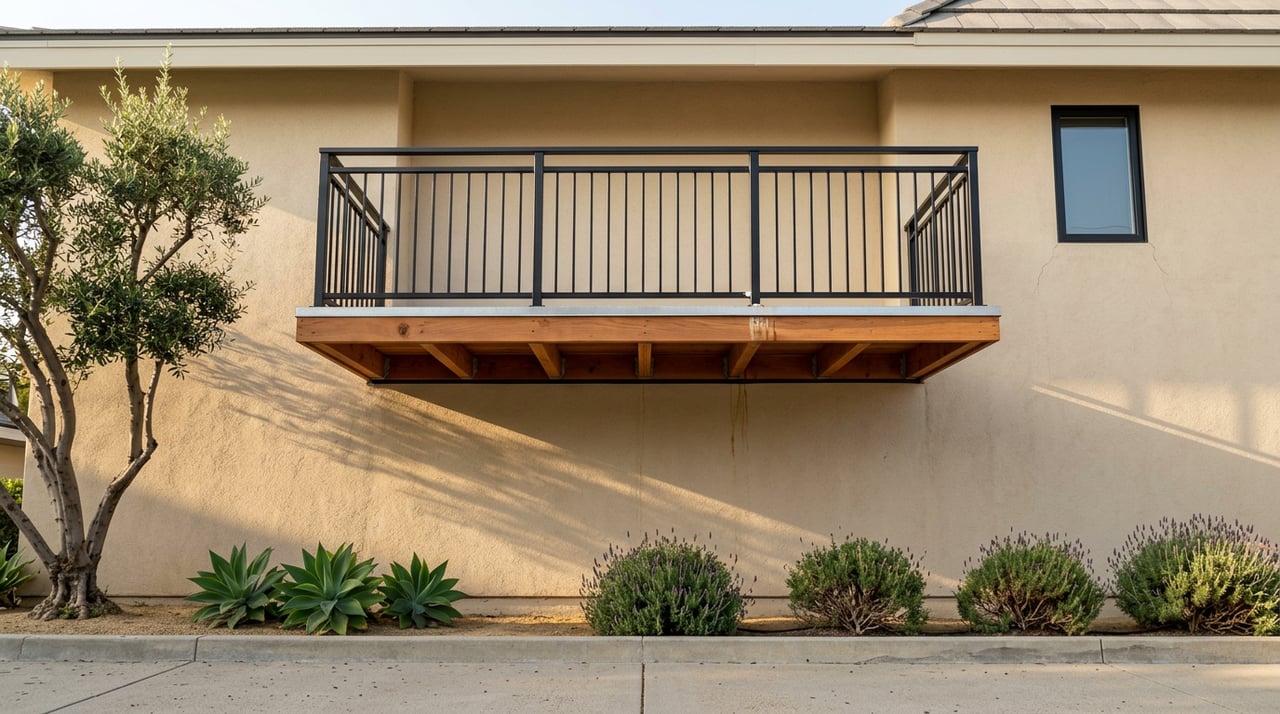
SB 326 was signed in 2019 and codified as Civil Code §5551 inside the Davis-Stirling Act. It requires every California condominium of three or more units to inspect wood-supported balconies, decks, walkways, and stairs elevated more than six feet above ground, then repeat that inspection every nine years. The initial deadline for all covered HOAs was January 1, 2025, and it was not extended. AB 2579's extension applied only to SB 721 for apartment buildings, a point that has confused a large number of California boards. AB 2114 did add licensed civil engineers to the pool of qualified inspectors alongside structural engineers and architects.
What changed for sellers is SB 410, Chapter 516 of the 2025 statutes. Effective January 1, 2026, it amended Civil Code §§4525, 4528, 5200, 5210, and 5551. The most recent §5551 inspection report is now part of the same statutory disclosure packet that already contains CC&Rs, budgets, reserve funding disclosure, insurance summary, minutes, and pending litigation. The report is treated as an association record and must be retained for two inspection cycles, roughly eighteen years. You can read the amended §4525 on the California Legislative Information site.
Every resale in a covered Brea community now runs through that document.
Where a missing report actually shows up
Fannie Mae and Freddie Mac warrantability. Lenders underwriting condo loans review HOA documents for reserve health, litigation, and now structural inspection compliance. A community with an unresolved SB 326 gap can be flagged non-warrantable, which pushes conventional buyers out of the deal and narrows your buyer pool to cash. In a Brea market where Redfin recorded a median sale price of about $1.2 million for the three months ending May 2026, the cash pool is not the pool you want to be selling into.
HOA insurance renewal. Carriers have started asking about SB 326 compliance status at renewal. A non-compliant community can see higher premiums, reduced coverage on structural claims, or explicit exclusion of balcony and deck losses. Buyers who cannot secure homeowner insurance on the unit cannot close.
The reserve study. Under Civil Code §5550 the inspection findings must be incorporated into the association's reserve study. If the report does not exist, the reserve study is legally incomplete, and any buyer's advisor reading it can see the gap.
Board fiduciary exposure. California Corporations Code §7231 holds directors to an ordinarily prudent standard. A board that knew the requirement and did not act is exposed on a breach of fiduciary duty theory if any elevated element fails, and D&O policies do not always cover willful non-compliance.
Escrow timeline. California associations must produce §4525 documents within ten days of a written request under §4530. SB 410 also tightened financial-records production: current fiscal year within ten business days, prior two years within thirty calendar days. A ten-day HOA delay is invisible in a slow market. It is a listing-killer where average time to pending sits near ten days, which is where Zillow's Home Value Index recently placed Brea.
The Brea math on ten days
Brea moves fast enough that the statute's clock and the market's clock collide. PropertyShark's Q1 2026 data showed a Brea median sale price of $1.1M and a median of $591 per square foot on 60 recorded transactions. Redfin measured the three months ending May 2026 at a $1.2M median with 29 days on market and an average of six offers per sale. Zillow's ZHVI has homes going to pending in about ten days.
Read those numbers together. The offers arrive in the first two weeks. The buyer's lender begins conditioning approval on the HOA packet the moment escrow opens. If the seller sends the §4525 request to the management company after accepting an offer, ten statutory business days is roughly the same window Brea buyers use to remove contingencies. Order the packet before the sign goes up and the timing pressure disappears. Order it after and the deal negotiates against your calendar.
Condominium form versus planned development
Not every attached home in Brea is a §5551 property. The trigger is the form of ownership. If unit boundaries are drawn at unfinished interior surfaces and the association maintains the building envelope, the community is a condominium and SB 326 applies. If owners hold fee simple to the structure and the lot underneath it, the community is a planned development and §5551 typically does not apply, even when the units share walls and roofs.
Which category your Brea community falls into is a CC&R question, not a curb-appeal question. Before you list, pull the recorded CC&Rs and confirm the form. Two visually identical Brea townhome tracts down the street from each other can land on opposite sides of this line. If you own a stand-alone Brea single-family home, you are not covered by §5551 at all, though the surrounding market conditions in this piece still apply to your timing.
A pre-listing sequence that works with the statute
- Two months before listing. Send a written §4525 request to the management company. Ask specifically for the most recent §5551 inspection report, its date, the inspector's name and license type, and whether any findings remain open.
- On receipt. Confirm the report is incorporated into the current reserve study. Confirm the board reviewed it at an open meeting and distributed the required written summary to owners within fifteen days of that meeting.
- If findings are open. For non-emergency items the statute allows a permit within 120 days of the inspection and work started within 120 days of that permit. Ask the board where each open item sits inside that window and get the answer in writing.
- If no report exists. The community is out of compliance. Talk to the board about scheduling an inspection now. A typical mid-size condominium project runs $15,000 to $40,000 for the initial inspection depending on unit count and destructive testing. That expense is an HOA reserve item, not yours, but the timing becomes yours.
- At listing. Deliver the report inside the §4525 packet the day contingencies begin. Do not wait for the buyer's agent to ask.
What the report actually says about your price
An SB 326 report is a structural document, but a Brea seller can read it as a pricing document. A clean report at a recent date supports the higher end of your comp range because the buyer's lender, insurer, and inspector all encounter a document that closes questions rather than opens them. A report with open non-emergency findings and a documented repair plan on file is still a defensible position, and the repair timeline is usually short enough that a well-priced listing absorbs the discount buyers would otherwise demand for uncertainty. A community with no report at all is where price and time on market start to slip against you, and where a seller's best move is often to spend a listing consultation working out what the association is willing to do before the sign ever goes in the ground.
The contractor read on those reports matters here. Distinguishing a note about waterproofing membrane maintenance from a note about load-bearing wood decay changes the negotiation completely, and neither belongs in a buyer's imagination when you can put the actual answer in the packet.
Quick FAQ
Does SB 326 apply to a two-story Brea townhome with private balconies over the garage? Only if the community is a condominium under the CC&Rs and the balcony is more than six feet above ground, supported substantially by wood, and maintained by the HOA. Some townhome associations have amended their CC&Rs to shift balcony maintenance to individual owners, which changes the analysis.
Who pays for the inspection, the seller or the HOA? The HOA. It is an association expense, funded from reserves or, if reserves are short, a special assessment on all owners.
Can a general contractor sign the SB 326 inspection? No. §5551 restricts the inspection to a licensed structural engineer, licensed architect, or, since AB 2114, a licensed civil engineer. A general contractor cannot certify a §5551 inspection even with decades of framing experience.
If you own a Brea condo or townhome and expect to list within the next twelve months, the HOA document trail is your first project, not your last. Daniel P. Garcia reads these reports as both a licensed agent and a licensed general contractor, and can help you decide what to fix, what to disclose, and how to price the result before the packet ever reaches a buyer. Request a Free Home Valuation & Renovation Plan.